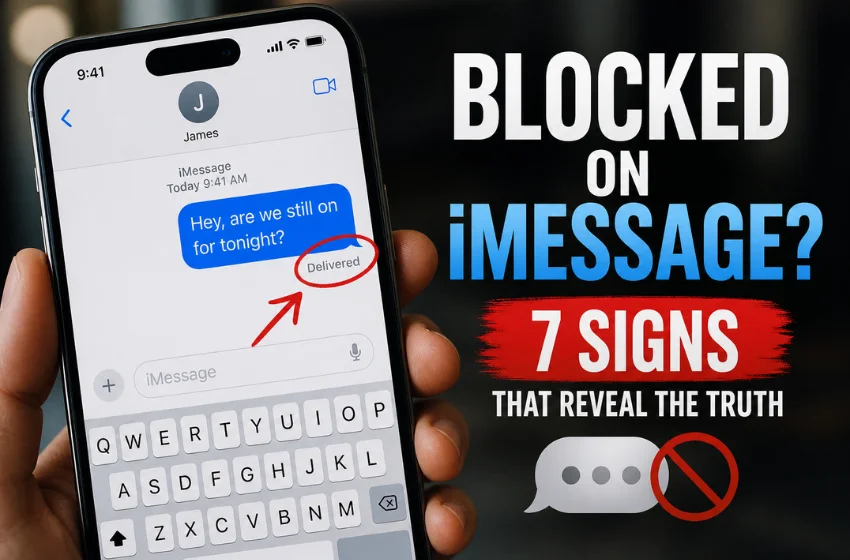

You sent the message. The blue bubble appeared. And now… nothing. No “Delivered.” No “Read.” Just silence.
Here’s the uncomfortable truth Apple won’t tell you: there is no official notification when someone blocks you on iMessage. By design. Apple’s whole thing is privacy and that privacy extends to the person doing the blocking. So you’re left reading signals, not certainties.
But those signals? They’re real. And once you know what to look for, you can piece together a very clear picture without sending another message, without calling, and without embarrassing yourself.
This guide covers every reliable sign that you’ve been blocked on iMessage, the things people get wrong (green bubbles don’t mean what you think), how iOS 26 changed the rules, and how to check without texting them at all. Whether it’s an ex, a friend, a coworker here’s what’s actually happening on your screen.
First: What Actually Happens When Someone Blocks You on iMessage?
Before reading the signs, understand the mechanics. When someone blocks your number on iPhone, a few things happen simultaneously:
- Your iMessages no longer reach their device
- Your calls go to voicemail after one ring (or immediately)
- Your FaceTime requests fail silently
- You receive no notification that any of this happened
From your end, everything looks almost normal. Your messages still appear to send. That deliberate ambiguity is Apple’s privacy design at work. The system is built so the blocked person can’t be 100% sure.
But “can’t be 100% sure” is not the same as “can’t tell at all.” Here’s how to read the evidence.
The 7 Signs Someone Blocked You on iMessage
Sign 1: No “Delivered” Notification Under Your Last Message
This is the most cited sign — and the most misunderstood one in 2026.
Under every iMessage you send, there’s normally a small label: “Delivered” or “Read.” When you’re blocked, that label disappears. Your message sends, the blue bubble appears, but no delivery confirmation ever shows up underneath.
The important iOS 26 caveat: In iOS 16.5 and later, Apple changed how delivery receipts work for blocked messages. Some users on newer software versions report still seeing “Delivered” even when blocked. This is because the system can cache a delivery status from a previous successful delivery. If you’re on iOS 26 (released 2026), treat “Delivered” as a weak signal either way its presence doesn’t guarantee you’re not blocked, and its absence alone isn’t proof you are.
What it means: No “Delivered” ever showing up combined with other signs is a strong indicator. On its own, it’s inconclusive.
Sign 2: Your Messages Switched from Blue to Green Bubbles
This one gets misread constantly. Let’s set it straight.
Blue bubbles = iMessage (Apple’s system, internet-based) Green bubbles = SMS or RCS (standard cellular text)
When iMessage can’t deliver a message to someone because they blocked you, turned off iMessage, switched to Android, or have no internet connection your iPhone automatically falls back to SMS. That fallback is what turns the bubble green.
The crucial distinction: Green bubbles alone do NOT confirm a block. They confirm that iMessage failed. Why it failed is what you need to figure out.
But here’s the telling combination: blue bubbles that suddenly turn green in a thread that was consistently blue, with no delivery confirmation and no reply that pattern is a strong signal.
Quick test: If you’re seeing green bubbles, check if you can reach this person any other way. If their iMessage is simply off or they’re without internet, the bubble should return to blue when they reconnect. If it stays green indefinitely, that tells you more.
Sign 3: Calls Go Straight to Voicemail After One Ring
Make a regular phone call. Not FaceTime a standard cellular call.
If you’re blocked: the call rings once (sometimes not even that) and drops immediately to voicemail.
If they’re simply unavailable, their phone is off, or Do Not Disturb is on: the phone rings multiple times before voicemail picks up.
One ring → voicemail = possible block. Multiple rings → voicemail = probably not blocked, just unavailable.
The Do Not Disturb problem: iOS Focus modes, including Do Not Disturb, can also send calls straight to voicemail. This is why calling once isn’t enough. Try at different times of day — morning, afternoon, evening. If it consistently goes to voicemail after one ring regardless of when you call, that’s a meaningful pattern.
Sign 4: FaceTime Calls Fail Immediately or Don’t Connect
Open the phone app, go to their contact, and try a FaceTime call.
If blocked: FaceTime will either fail instantly with a connection error or ring once and drop.
If not blocked but unavailable: FaceTime will ring normally for several seconds before timing out.
This test is slightly more reliable than a regular call because FaceTime failure has fewer innocent explanations; it requires both an active internet connection and a working iMessage setup on the receiver’s end.
Sign 5: Read Receipts That Used to Appear Have Stopped
This requires some history. If you’ve previously seen “Read” receipts from this person you could see the time they opened your message and those receipts have now completely stopped, something changed.
Two possibilities:
- They turned off read receipts (Settings → Messages → Send Read Receipts)
- You’ve been blocked
There’s no way to distinguish these from your end. But consider context: did this change happen alongside the other signs above? Did their responsiveness drop off simultaneously? The pattern matters.
Sign 6: The “Send as Text Message” Option Appears
When an iMessage fails to deliver, iOS sometimes shows a prompt: “Send as Text Message.”
If you see this appearing repeatedly for messages to one specific person someone who never used to trigger this that’s another data point. iMessage is failing for some reason. Combined with the other signals, it adds weight.
Tap the option if you want to attempt an SMS fallback. If the SMS also shows no delivery confirmation and gets no reply, the case for being blocked gets stronger.
See Also : Droven.io: AI Technology, IT Services & Business Automation Platform for the USA
Sign 7: No Activity on Social Media or Other Platforms Either
This is the “without texting them” method and it’s the cleanest way to check.
If you suspect a block, look for evidence elsewhere:
- Check Instagram, Facebook, WhatsApp, or Snapchat. Can you see their profile? Has their profile picture disappeared or are they no longer in your contacts list?
- Try sending a message on another platform. Does it go through normally?
- Check if you can still see their “last seen” or activity status on WhatsApp
If you’re blocked on iMessage and also can’t find them on other platforms, or your messages on other apps also show no delivery the picture becomes very clear.
If you can reach them perfectly well on Instagram but iMessage won’t deliver that’s actually useful information too. It suggests a deliberate iMessage block rather than a technical problem.
How to Tell If Someone Blocked You on iMessage Without Texting Them
This is one of the most common searches and for good reason. Sending another message to someone who may have blocked you feels uncomfortable and potentially intrusive. Here are the no-text methods:
Method 1: Try a FaceTime call FaceTime uses the same blocking system as iMessage. If it fails immediately or after one ring, that’s a signal and you haven’t sent them a text.
Method 2: Check their social media presence As above a cross-platform check tells you a lot without initiating contact via iMessage.
Method 3: Check your iMessage thread for the last “Delivered” or “Read” label. You don’t need to send a new message. Scroll to the last message you sent and look at what’s underneath it. If it was “Delivered” and is now gone or if it never showed up that’s telling you something without requiring a new send.
Method 4: Ask a mutual contact (carefully) If you share mutual friends who also have this person’s number, you could casually check whether they’re also experiencing silence or whether this person is clearly active and online. This is social context, not a technical method, but it’s often the most conclusive.
Method 5: Use a different number This is the definitive test and it works. Use a friend’s phone (someone the person definitely hasn’t blocked) to send a quick iMessage. If it delivers normally and shows “Delivered” immediately, the iMessage system is working fine for this person. That removes every innocent technical explanation and points squarely at a block on your specific number.
The iOS 26 Update: What Changed
iOS 26, released in 2026, introduced several changes that affect how blocking-related signals behave:
- Call screening tools for unknown numbers were expanded calls from unknown or unrecognized numbers can now be auto-screened and silenced without ringing at all, without a block being in place
- Message filtering improvements mean more messages from unrecognized senders get routed to a filtered inbox rather than the main Messages view this can look like silence even without a formal block
- Focus modes became more granular someone can now allow only specific contacts through during work hours or sleep hours, making it harder to distinguish Focus-based silencing from a block
The practical implication: Before assuming a block in 2026, rule out Focus mode silencing as a cause. If you’re someone who contacts this person infrequently or from a number they haven’t saved, iOS 26’s unknown sender filtering may simply be routing your messages to a folder they haven’t checked.
See Also : Messagenal: What It Is, How It Works, and Everything You Need to Know
Myth vs. Fact: iMessage Blocking in 2026
| Myth | Fact |
| Green bubbles = you’re blocked | Green bubbles mean iMessage failed could be a block, could be no internet, could be Android |
| “Delivered” means you’re definitely not blocked | On iOS 16.5+, some devices still show “Delivered” even when blocked due to cached delivery status |
| If you’re blocked, your message won’t send at all | It just never reaches them. You’ll see a blue bubble and nothing after it |
| No “Read” receipt means you’re blocked | Read receipts can be disabled by anyone in Settings this alone means nothing |
| One ring to voicemail = definite block | Focus mode and Do Not Disturb also send calls to voicemail after minimal ringing |
| You can 100% confirm a block from your own device | There is no guaranteed, foolproof confirmation method from your end |
Signs You’re Probably NOT Blocked
Not every silence is a block. Before spiraling, rule these out:
- They have Do Not Disturb or Focus mode on messages and calls go through but notifications are silenced. They’ll see everything when they check their phone.
- They switched to Android their iMessage is off, bubbles go green, your calls go to voicemail. Looks exactly like a block from your end.
- Their phone is off or out of battery, no delivery, no response. Temporary.
- They’re traveling internationally. iMessage requires data or WiFi. If they’re without connectivity, delivery fails silently.
- iMessage is down. Apple has occasional outages. Check Apple’s System Status page before drawing conclusions.
- They simply haven’t responded to the most common, most overlooked explanation.
The pattern that actually indicates a block: multiple signs appearing simultaneously, consistently, over multiple days, with no innocent explanation that fits.
What to Do If You Think You’ve Been Blocked
I know all people know how to react if someone special blocks you but for some people First take a breath. Being blocked is uncomfortable, but it’s a boundary someone has set deliberately. Trying to circumvent it (calling from different numbers repeatedly, messaging on every platform) is not going to end well and isn’t respectful of that boundary.
Practical steps:
- Wait a day or two before doing anything. Technical glitches happen.
- Try the mutual contact or different number test once quietly, not repeatedly.
- If the signs are consistent and conclusive, accept the information.
- If there’s a genuine urgent reason to make contact (shared practical matters, emergencies), reach out through a different communication channel once.
What you shouldn’t do: send message after message hoping one gets through, use multiple numbers to bypass the block, or assume something technical is wrong when the evidence points elsewhere.
Conclusion
Here’s the honest summary: Apple deliberately makes it impossible to know with 100% certainty that you’ve been blocked on iMessage. That’s a privacy decision, and it’s the right one.
What you can do is read the pattern of signals. No “Delivered” confirmation. Blue bubbles going green with no return. One ring to voicemail, consistently. FaceTime failed immediately. No read receipts where there used to be. Cross-platform silence. Taken together, these signals tell a clear story even if no single one is definitive proof.
And in 2026, with iOS 26 changing how delivery receipts behave and adding new screening features, the read on these signals requires more nuance than it used to. Green bubbles mean less than they used to. “Delivered” means less too. Pattern recognition over multiple signals, over multiple days, is what actually tells you what’s going on.
If the pattern is clear, give yourself the answer, respect the boundary, and move forward.
Next steps: If you want to go the other direction, learn how to block someone on your iPhone yourself, or how to set up Focus mode to manage who can reach you those guides cover the exact settings to use. For see more help full guides must visit Decretosupremo160 .
Frequently Asked Questions
On older iOS versions, no blocked messages showed no “Delivered” status. On iOS 16.5 and later, including iOS 26, behavior has changed and some users report seeing “Delivered” even when blocked due to cached delivery data. It is no longer a reliable standalone indicator.
Try a FaceTime call if it fails immediately or after one ring, that’s a signal without sending a text. You can also check their social media profiles for signs of blocking, or review your existing message thread to see if previous messages ever showed “Delivered” or “Read.” A mutual friend’s phone is the most reliable test.
Not necessarily. Green bubbles mean your iPhone switched from iMessage to SMS which happens when iMessage fails for any reason. This includes: the recipient blocking you, them switching to Android, their iMessage being off, or them having no internet connection. Green bubbles alone are not confirmation of a block.
Yes. When someone blocks your number on iPhone, it applies to all communication iMessage, SMS, phone calls, and FaceTime. The calls will go to voicemail after one ring or less.
No. iPhone blocking is number-level when you block a contact, all communication from that number is blocked simultaneously: calls, texts, and FaceTime.
Somewhat. iOS 26 introduced expanded call screening and message filtering for unknown senders, which can mimic the appearance of a block without one actually being in place. If you’re not saved in someone’s contacts and they use iOS 26’s new filtering features, your messages may route to a filtered folder automatically appearing as silence even without a deliberate block.

Daniel Brooks is a business writer with a strong interest in entrepreneurship, startups, marketing strategies, and company growth. He shares practical insights and easy-to-follow content to help readers stay informed about the latest business trends and opportunities.