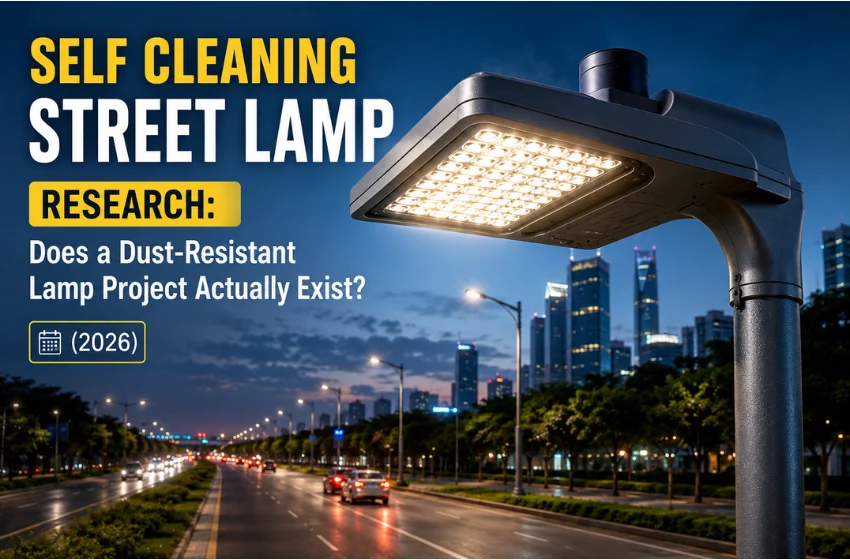

Short answer: yes, it exists. In fact, it’s been in active development for years and in 2026, several versions of it are already deployed in real cities.
The longer answer is more interesting. self cleaning street lamp research dust resistant lamp project exist isn’t one project it’s a convergence of four separate technologies that researchers and engineers are combining into something genuinely useful for urban infrastructure. Understanding what those technologies are, how they work together, and where they’ve already been deployed tells you exactly why this research matters and where it’s headed.
Here’s the full Guide.
Why Does This Research Exist? The Problem It’s Solving
A standard street lamp loses between 20% and 40% of its light output within its first year of operation — not because the bulb degrades, but because dust, pollution particles, bird droppings, and environmental debris coat the lens and housing.
That light loss has real consequences:
- Road safety drops as illumination falls below design standards
- Energy waste increases because the lamp draws the same power while producing less light
- Maintenance costs rise as crews must physically clean or replace units on a schedule
- Lamp lifespan shortens because heat trapped by dust buildup stresses internal components
In dense urban environments and especially in desert climates the Middle East, North Africa, parts of Asia dust accumulation is severe enough that some lamps lose functional effectiveness within weeks. One of the most overlooked challenges in street lighting systems is maintenance, particularly the accumulation of dust, dirt, pollution, bird droppings, and environmental debris on lamp surfaces.
That’s the problem self-cleaning research is engineered to solve.
The 4 Technologies Behind Self-Cleaning Street Lamps
The research doesn’t rely on a single breakthrough it stacks four distinct approaches, each addressing a different part of the dust problem.
Technology 1: Hydrophobic and Photocatalytic Surface Coatings
The simplest and most scalable solution. Special coatings are applied to the lamp’s outer surface that make dust and water bead up and roll off rather than stick and accumulate.
Hydrophobic coatings (super water-repellent surfaces, often nano-silica or fluoropolymer-based) cause water droplets to carry dust particles away as they slide off essentially using rain or condensation as a passive cleaning mechanism.
Photocatalytic coatings (typically titanium dioxide, TiO₂) go further. When exposed to UV light — which street lamps produce as a byproduct TiO₂ triggers a chemical reaction that breaks down organic contaminants on the surface into CO₂ and water. The surface essentially digests organic dirt.
Combined, these coatings mean the lamp cleans itself continuously during normal operation, with no moving parts, no power draw, and zero maintenance intervention.
Technology 2: Automated Mechanical Cleaning Systems
For environments where coatings alone aren’t sufficient in high-dust deserts, industrial zones, heavily polluted urban areas researchers developed mechanical cleaning systems.
These range from simple wiper mechanisms (similar in concept to windshield wipers) to more sophisticated robotic brush arms that deploy on a timer or sensor trigger. A robotic brush system periodically sweeps the panel to remove accumulated dust and debris, ensuring maximum power generation.
The key engineering challenges here are:
- Sealing: The mechanism must not create new entry points for dust into the lamp housing
- Power efficiency: The cleaning motor must draw minimal energy relative to the power saved by maintaining clean optics
- Durability: Moving parts in outdoor environments degrade over time designs need to be reliable across 5–10 year operational cycles
Patents for self-cleaning street lamp poles including sliding plate mechanisms driven by internal control ropes solve problems with cleaning street light poles in environments where passing vehicles cause dust and sand to adhere to outer walls.
See Also : How Can We Empower the Disaster Management Crew? 7 Strategies That Actually Work
Technology 3: Dust-Resistant Sealed Housing Design
The third approach works preventatively rather than reactively engineering the lamp so dust can’t accumulate in the first place.
Key design principles:
- IP65/IP66 rated enclosures: Completely dust-tight sealing at all joints and connectors. Any gaps could allow fine sand to penetrate and coat the electronics or LEDs.
- Smooth, angled surfaces: Eliminating flat horizontal surfaces where dust settles. Angled panels (typically 15–35° tilt) allow loose particles to slide off under gravity and wind
- Minimal crevices: Streamlined housing profiles with no recessed areas where debris accumulates
- Marine-grade materials: Aluminum alloy and stainless steel fasteners that resist corrosion even in sand-blown, high-UV environments
This is passive engineering no power, no moving parts, just geometry and materials doing the work.
Technology 4: Smart Sensors and IoT Monitoring
The newest layer. Modern self-cleaning street lamp projects integrate dust sensors that measure particle accumulation in real time and trigger cleaning cycles only when needed rather than running on fixed schedules regardless of actual conditions.
Dust sensor technology combined with microcontrollers and threshold-based cleaning algorithms enables efficient operation while preserving battery longevity in extreme heat.
The smart system layer includes:
- Dust load sensors that measure optical degradation and trigger cleaning at defined thresholds
- Remote monitoring dashboards giving city infrastructure managers real-time visibility across entire lamp networks
- IoT interfaces allowing adjustment of cleaning frequency for individual lamps from a central control room
- Predictive maintenance alerts that flag units showing abnormal degradation before failure occurs
By 2026, the solar lighting industry has shifted from simply providing light to intelligent lighting, and the self-cleaning solar street light is no longer a niche innovation but a critical infrastructure component for modern smart cities.
Does a Real Project Actually Exist? Yes Here’s the Evidence
This isn’t theoretical research sitting in academic papers. Real deployments exist.
Gletscher Energy Stellar Series Middle East Deployment
Among the most documented real-world implementations. The all-in-one aluminum alloy housing and pole mounting enable quick deployment in remote areas while withstanding sand, dust, and extreme heat. Deployed across highways, airports, and smart city projects in Saudi Arabia and the UAE environments where dust accumulation is among the most severe on Earth.
SRESKY Thermos Series China, Smart City Projects
Backed by over six years of market validation, a complaint rate below 0.7%, and three core technologies (TCS + FAS + ALS), the SRESKY Thermos series remains the top choice for large-scale government infrastructure projects and extreme operating conditions. The TCS (Thermal Control System), FAS (Fan + Air System), and ALS (Auto-Luminance System) work in combination to manage dust, heat, and light output simultaneously.
Patent Record CN109647747B
A granted Chinese patent covers a specific self-cleaning street lamp pole mechanism: a pole body with a cavity containing a U-shaped partition, a driving mechanism, and a control rope system connected to a slide plate that enables automated cleaning of exterior surfaces. The patent demonstrates that functional mechanical designs have already cleared the intellectual property stage, a reliable indicator of real engineering investment.
Academic Research Projects
University engineering departments in several countries including institutions in the UK, UAE, and China have published research on dust-resistant LED street lamp design using TiO₂ photocatalytic coatings and automated wiper mechanisms. These projects combine environmental testing for dust and UV exposure, embedded programming, and IoT monitoring as a unified research framework.
Comparison: Self-Cleaning Methods at a Glance
| Method | How It Works | Best For | Moving Parts | Cost Level |
| Hydrophobic coating | Water beads up, carries dust away | Mild-moderate dust environments | None | Low |
| Photocatalytic (TiO₂) coating | UV light breaks down organic contaminants | Urban pollution, organic debris | None | Low-Medium |
| Robotic/mechanical brush | Motorized arm physically sweeps surface | High-dust, desert environments | Yes | Medium-High |
| Sealed IP65/66 housing | Prevents dust entry through design | All environments (baseline) | None | Medium |
| Smart sensor + IoT system | Triggers cleaning only when needed | Large urban networks, smart cities | Depends on method | High |
What’s Still Being Researched
The technology works. The remaining research questions are about scale, cost, and reliability over time.
Durability of mechanical systems: Robotic brush arms and wiper mechanisms have a finite service life. Research is ongoing into materials that reduce wear while maintaining cleaning effectiveness across 10+ year operational cycles.
Coating longevity: Photocatalytic and hydrophobic coatings degrade with UV exposure over time. Current research focuses on nano-composite formulations that maintain effectiveness for 5–7 years without reapplication.
Cost reduction: Higher initial costs are offset by stable ROI over a 5–8 year cycle, offering unmatched reliability and reduced maintenance burden but reducing upfront cost is key to wider municipal adoption.
Standardization: With multiple competing approaches (coatings vs. mechanical vs. smart sensors), the industry lacks a unified standard. Research institutions and standards bodies are working toward testable performance benchmarks that would allow cities to specify and compare products consistently.
See Also : Droven.io AI Technology, IT Services & Business Automation Platform for the USA
Myth vs. Fact
| Myth | Fact |
| “Self-cleaning street lamps are just a concept” | Multiple commercially deployed products exist in 2026, with real-world installations across three continents |
| “Self-cleaning means zero maintenance forever” | It means dramatically reduced maintenance frequency not complete elimination. Mechanical systems still require periodic inspection |
| “These lamps only work in dry climates” | Hydrophobic coatings actually work better in wet climates where rain acts as the cleaning agent |
| “The cleaning mechanism wastes too much energy” | Smart sensor-triggered systems use cleaning energy only when needed, and the energy saved by maintaining clean optics far exceeds cleaning power draw |
| “TiO₂ coatings are new technology” | Titanium dioxide photocatalysis has been studied since the 1970s. Street lamp applications are a more recent implementation of well-established chemistry |
Final Words
Self-cleaning street lamp research is real, the dust-resistant lamp project exists, and deployments are already operating in some of the harshest dust environments on Earth.
The technology stacks four approaches: surface coatings, mechanical cleaning, dust-resistant housing design, and smart IoT monitoring into systems that maintain consistent light output with minimal human intervention. What started as applied engineering research has moved through patents, university trials, and commercial production into live smart city infrastructure.
The remaining questions aren’t whether it works. They’re about standardization, long-term durability, and getting unit costs low enough for widespread municipal adoption problems that ongoing 2026 research is actively solving.
What to read next: Explore how AI and IoT are transforming the broader smart city infrastructure and how smart street lighting fits into that picture.
Visit Decretosupremo160 for more in-depth research and insights.
Frequently Asked Questions
Yes. Multiple real-world commercial deployments exist in 2026, including the Gletscher Energy Stellar Series in the Middle East and the SRESKY Thermos series in China. Academic research projects at engineering universities across the UK, UAE, and China have published findings on dust-resistant lamp design combining photocatalytic coatings, sealed housing, and IoT monitoring.
Most modern designs combine two or more approaches: surface coatings that repel dust and break down organic contamination using UV light, sealed IP65/66 housings that prevent dust ingress through engineering, and in high-dust environments, automated mechanical brush or wiper systems that physically clear accumulated particles on a sensor-triggered schedule.
The most common materials are TiO₂ photocatalytic coatings, nano-silica or fluoropolymer hydrophobic coatings, marine-grade aluminum alloy housing, and stainless steel fasteners. Smooth angled surfaces and sealed enclosures complete the passive dust-resistance design.
IP (Ingress Protection) ratings define how well a sealed enclosure resists solid particles and water. IP65 means completely dust-tight and protected against water jets. IP66 means completely dust-tight and protected against powerful water jets. Both ratings are considered baseline requirements for outdoor street lamp installations in dusty environments.
Yes, over a full operational lifecycle. Higher upfront costs are offset by dramatically reduced maintenance frequency, longer lamp lifespan, and consistent light output (meaning energy isn’t wasted on degraded optics). ROI timelines of 5–8 years are well-documented in commercial deployments.

Olivia Carter creates simple and informative how-to guides covering everyday solutions, digital tools, productivity tips, and practical tutorials. Her goal is to make complex topics easy for readers through clear and engaging step-by-step content.