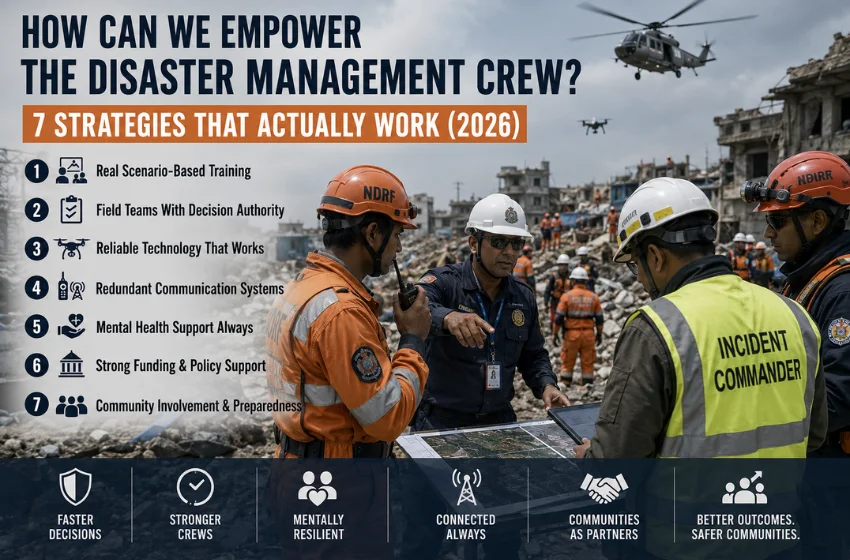

Disasters don’t fail because of a lack of good intentions. They fail because the people on the ground are working inside broken systems with unclear authority, communication gaps, outdated tools, and zero psychological support.
That’s the real problem. And that’s exactly where empowerment starts.
Empowering a disaster management crew isn’t just buying better equipment. It means building a system designed around the people doing the actual work giving them the training, the authority, the technology, and the mental resilience to act fast when every second counts.
Here are the 7 strategies that genuinely make a difference.
1. Build Training Around Real Scenarios, Not Textbooks
Generic training doesn’t prepare people for chaos. Real empowerment means training that mirrors actual disaster conditions pressure, noise, incomplete information, and split-second decisions.
What effective training looks like:
- Simulation-based drills that replicate specific disaster types: floods, wildfires, industrial accidents, earthquakes. Not abstract exercises scenarios pulled from real past events.
- Cross-training across roles so crew members can step into adjacent responsibilities when someone goes down or comms break
- Decision-making drills where teams practice making calls with incomplete information because that’s always what happens in the field
- After-action reviews after every drill, not just real events. The debrief is where learning actually happens.
The goal isn’t a crew that knows the procedure. It’s a crew that can adapt when the procedure stops working.
2. Give Field Teams Real Decision-Making Authority
This is the most overlooked empowerment strategy and the most impactful.
Disaster environments change by the minute. Waiting for top-down approval before acting costs lives. A rescue window that exists at 9:04 AM may be gone by 9:11 AM.
Empowered crews have pre-authorized decision frameworks: clear guidelines on what they can do without seeking permission. This isn’t about removing accountability, it’s about removing unnecessary friction at the moment when speed matters most.
Practical steps:
- Define tiers of decision authority by role what each team lead can authorize independently
- Pre-approve resource allocation protocols for common scenarios
- Eliminate sign-off chains for time-critical field decisions
- Brief crews thoroughly on their authority boundaries so they act with confidence, not hesitation
A crew that has to wait for approval is a crew that arrives late.
See Also : Describe How This Exercise Demonstrates the Principle of Phage Typing
3. Equip Teams With Technology That Works Under Pressure
Technology empowers disaster crews when it’s reliable, simple to use under stress, and doesn’t require internet connectivity to function.
The tools that matter most in 2026:
| Technology | What It Does | Why It Matters |
| Drones with thermal imaging | Real-time aerial reconnaissance of disaster zones | Covers ground impassable for humans safely |
| GIS mapping software | Live situational maps showing affected areas, resources, personnel | Shared picture across all teams and command |
| Satellite communication devices | Comms that work when mobile networks fail | Networks fail first in every major disaster |
| Wearable sensors | Monitor crew health vitals in real-time | Prevent casualties from heat exhaustion, overexertion |
| AI-powered predictive analytics | Forecast disaster spread, resource needs, hotspots | Shift from reactive to proactive response |
| Offline-capable mobile apps | Data access without internet connectivity | Most disaster zones lose connectivity immediately |
One critical rule: technology only empowers if the crew is trained on it before the disaster. A tool nobody knows how to use under pressure is useless.
4. Fix Communication The System That Fails First
When disasters hit, communication infrastructure is typically the first thing that fails. Power goes down, cell towers overload, internet drops. And that’s the moment when your crew needs to communicate most.
A genuinely empowered crew has redundancy built in:
- Primary: Digital platforms for real-time updates between field teams and command
- Secondary: Radio networks (TETRA, satellite radio) that operate independently of civilian infrastructure
- Tertiary: Offline protocols physical signal systems, pre-agreed fallback meeting points, runner systems for last-resort communication
Beyond infrastructure, communication empowerment also means clarity of language. Every crew member speaks the same terminology. No ambiguity about what “secure the perimeter” means. No confusion about which channel covers which zone.
Miscommunication in disaster response doesn’t just slow things down. It kills people.
5. Prioritize Mental Health Before, During, and After
This is the strategy most organizations talk about and fewest actually implement properly.
Disaster crews experience what others don’t: they see death, destruction, and suffering at scale, repeatedly, often without adequate time to process between deployments. The result is burnout, PTSD, anxiety, and impaired decision-making none of which are weaknesses of character. They’re predictable outcomes of unmanaged occupational trauma.
What genuine mental health empowerment looks like:
- Pre-deployment psychological preparation: stress inoculation training, resilience-building sessions before crews go in
- During-deployment support: rotation schedules that limit continuous exposure, brief daily check-ins with mental health liaisons embedded in teams
- Post-deployment debriefs: structured psychological debrief sessions within 72 hours of returning from deployment not optional, not informal
- Long-term access: standing access to counselors and peer support networks without stigma or career consequences for using them
A mentally healthy crew makes better decisions, recovers faster between deployments, and stays in the profession longer. Mental health isn’t a soft consideration, it’s an operational one.
6. Secure Funding and Policy Support That Holds Under Pressure
Empowerment without institutional backing is fragile. The best-trained crew in the world becomes ineffective the moment their equipment budget gets cut or their authority is overridden by administrative processes during a crisis.
What structural empowerment looks like:
- Dedicated, ring-fenced funding for training, equipment, and personnel not contingent on non-disaster budget cycles
- Clear legislative authority defining who can authorize what during declared emergencies, removing ambiguity at the policy level
- Inter-agency coordination agreements pre-signed before disasters occur, so when multiple agencies respond, roles don’t overlap or conflict
- Post-disaster investment reviews: formal reviews after every major event that produce mandatory budget and policy changes, not just reports that sit on shelves
Governments that fund disaster crews adequately in non-disaster years are the ones whose populations suffer least when disasters happen.
7. Involve the Community They Are Part of the Crew
The most resilient disaster response systems treat communities not as passive victims to be rescued but as active participants in the response.
Community members who are trained in basic first aid, search and rescue protocols, and emergency communication can dramatically extend the reach of a professional crew. They know the local terrain. They know where the vulnerable residents live. They speak the language.
How to build community empowerment:
- Regular public preparedness drills at neighborhood level
- Community Emergency Response Team (CERT) training programs
- Clear public communication frameworks so communities know what to do and what NOT to do when disaster strikes (well-meaning untrained volunteers often create additional hazards)
- Local leadership identification community members who can coordinate neighbors during the window before professional crews arrive
When the community is prepared, professional crews arrive in organized, partially-managed situations rather than pure chaos.
The Real Barriers and How to Address Them
Most disaster management organizations already know these strategies. The gap is always implementation. Here’s what actually gets in the way:
| Barrier | What It Looks Like | How Empowerment Addresses It |
| Bureaucratic delays | Approval chains that slow field decisions | Pre-authorized decision frameworks by role |
| Underfunding | Outdated equipment, cancelled training cycles | Ring-fenced dedicated disaster budgets |
| Communication failure | Network collapse in disaster zones | Redundant multi-channel communication systems |
| Psychological attrition | Burnout, PTSD, crew turnover | Structured mental health support at every stage |
| Poor inter-agency coordination | Duplicate efforts, conflicting authority | Pre-signed coordination agreements |
| Technology gaps | Tools that don’t work offline or under stress | Tested, offline-capable tech with mandatory training |
Conclusion
Empowering a disaster management crew comes down to one principle: design the system around the people doing the work, not around the paperwork.
That means training for reality, not compliance. Authority that doesn’t wait for bureaucracy. Technology that works when infrastructure fails. Communication that has a backup, and a backup to the backup. Mental health support that’s treated as essential as equipment. Funding that doesn’t disappear between disasters. And communities that are partners, not just recipients.
When those pieces are in place, disaster management crews don’t just respond, they perform. And performance, when disaster strikes, is the difference between communities that recover and communities that don’t.
What to read next: Learn how AI tools are transforming disaster preparedness and response in 2026 and what that means for the crews on the ground. See Also more helpful guides and explore Decretosupremo160.
Frequently Asked Questions
The highest-impact combination is decision-making authority at field level, scenario-based training, reliable redundant communication systems, and structured mental health support. Equipment matters but systems that free crews to act quickly and confidently at the moment of crisis have the most direct effect on outcomes.
Disaster crews face repeated exposure to traumatic environments. Without structured support before, during, and after deployments burnout and PTSD degrade decision-making, reduce crew retention, and ultimately compromise the quality of response when communities need it most.
Technology provides real-time situational awareness, enables communication when standard networks fail, extends the reach of crews into hazardous zones via drones, and shifts response from reactive to proactive through predictive analytics. Critically, it only empowers when crews are trained on it before deployment.
Prepared communities reduce the chaos that crews arrive into. Community members trained in basic first aid, local terrain knowledge, and emergency protocols can manage the first critical window before professional crews reach the scene and act as force multipliers once they do.
The gap between planning and execution. Most organizations have adequate plans on paper. The failure point is field-level implementation crews constrained by unclear authority, failed communications, or undertrained responses to conditions that didn’t match the simulation.

Olivia Carter creates simple and informative how-to guides covering everyday solutions, digital tools, productivity tips, and practical tutorials. Her goal is to make complex topics easy for readers through clear and engaging step-by-step content.