
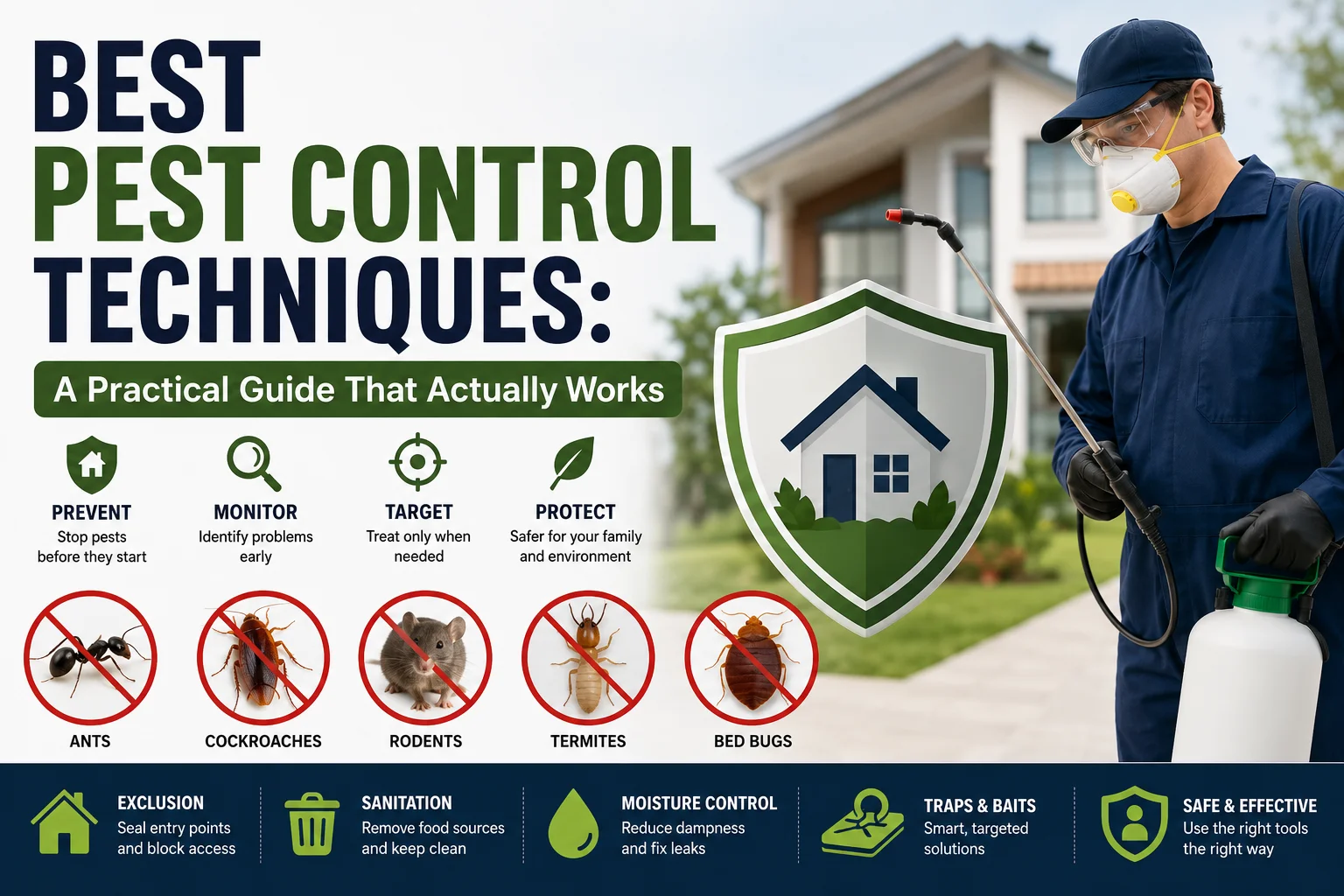
Spraying a can of bug killer when you spot an ant trail feels productive, but it rarely solves the actual problem. Pests keep coming back because something in your home is still attracting them. The most effective pest control combines a few different techniques, applied in the right order, rather than relying on one product.
The Foundation: Integrated Pest Management (IPM)
Professional pest control companies build their work around a framework called Integrated Pest Management, or IPM. The EPA describes it as an approach that combines common-sense practices based on current information about pest life cycles and how they interact with the environment, using that information to control pests with the least possible risk to people and the environment. US EPA
The core idea is simple: prevention comes first, monitoring tells you if you have a real problem, and treatment including pesticides is used only when it’s actually needed, not on a fixed schedule. IPM focuses on prevention and uses pesticides only as needed, which the EPA considers a more effective and environmentally sensitive approach than routine pesticide application. US EPA
This matters for homeowners because it flips the usual order of operations. Instead of treating first and hoping it works, you prevent, monitor, then treat.
Prevention Techniques (Stop Pests Before They Start)
Exclusion
Sealing the ways pests get in is the single highest-value pest control technique, because it addresses the root cause instead of the symptom. That means caulking gaps around pipes and wiring, repairing torn window screens, adding door sweeps, and sealing foundation cracks. Exclusion barriers, along with traps, bait stations, screens, and door sweeps, are commonly used to keep pests out and prevent them from returning; this applies especially to rodents and other crawling pests. Yonkers Times
Sanitation
Pests come inside looking for food, water, or shelter. Removing easy access to all three cuts down on infestations before they start:
- Store food (including pet food) in sealed containers
- Take out trash regularly and use bins with tight lids
- Wipe down counters and clean up crumbs promptly
- Clear yard debris, woodpiles, and leaf litter away from the foundation
Moisture Control
Damp conditions attract cockroaches, termites, and rodents alike. Fix leaking pipes, use a dehumidifier in damp basements or crawl spaces, and make sure gutters direct water away from the foundation.
Monitoring and Identification
Before treating anything, figure out what pest you’re actually dealing with and how bad the problem is. Not every pest sighting requires action; seeing a single pest doesn’t automatically mean control action is needed, and treatment decisions should be based on the actual scale of the problem, not a one-time sighting. EPA
Sticky traps, visual inspections, and tracking where you see activity (kitchen, bathroom, attic) help you identify the pest correctly and target treatment where it will actually work.
Non-Chemical Control Techniques
Traps and Bait Stations
Mechanical traps and bait stations are effective for rodents and many crawling insects without introducing broad pesticide use into your home. Bait stations work particularly well for ants and cockroaches because the pests carry the bait back to the colony.
Heat and Cold Treatments
For pests like bed bugs, heat treatment (raising a room’s temperature high enough to kill bugs and eggs) is a well-established non-chemical option, often used by professionals with specialized equipment.
Biological Control
In gardens and yards, introducing natural predators, ladybugs for aphids, for example, can reduce pest populations without chemicals. This technique is more common in agricultural and garden settings but applies to home landscaping too.
Chemical Control: When and How to Use It Safely
Pesticides still have a place in effective pest control, but IPM treats them as one tool among several rather than the default. When chemical treatment is necessary:
- Use EPA-registered products and follow label instructions exactly
- Target the specific pest and location rather than broad indoor spraying
- Consider professional application for termites, severe infestations, or situations involving children or pets
The EPA specifically prioritizes children’s health in pest management guidance, which is part of why prevention and targeted treatment are recommended over routine, broad pesticide use.
Technique by Pest Type
| Pest | Most Effective First Step | Notes |
| Ants | Sanitation + bait stations | Sprays often scatter colonies instead of eliminating them |
| Cockroaches | Sanitation + moisture control | Gel baits work well in cracks and under appliances |
| Rodents | Exclusion + traps | Seal entry points first, or new rodents will keep arriving |
| Termites | Professional inspection | DIY treatment rarely reaches the full colony |
| Bed bugs | Heat treatment or professional pest control | Over-the-counter sprays often fail to reach hidden eggs |
DIY vs. Professional Pest Control
Prevention and monitoring are things every homeowner can do. But certain situations call for a licensed professional:
- Termite infestations (structural risk, requires specialized treatment)
- Large or recurring rodent problems
- Bed bugs (DIY treatment has a high failure rate)
- Any pesticide application in homes with young children, pregnant occupants, or pets, where exposure risk needs professional judgment
FAQ
What is the most effective pest control method?
There isn’t one single method; the most effective approach combines prevention (exclusion, sanitation), monitoring, and targeted treatment, which is the basis of Integrated Pest Management.
Do I need to hire a professional, or can I do pest control myself?
Prevention and monitoring are DIY-friendly. Termites, bed bugs, and large infestations are usually best left to licensed professionals, since these often require equipment or treatment access homeowners don’t have.
Is Integrated Pest Management (IPM) only for farms?
No. The EPA notes that IPM applies to agricultural and non-agricultural settings alike, including homes, gardens, and workplaces.
Conclusion
Effective pest control isn’t about finding the strongest spray, it’s about sealing entry points, removing what attracts pests in the first place, monitoring for early signs, and treating only when and where it’s actually needed. That combination, not any single product, is what keeps pests from coming back.
7. Sources
- U.S. EPA “Integrated Pest Management (IPM) Principles” (epa.gov/safepestcontrol/integrated-pest-management-ipm-principles)
- U.S. EPA “Introduction to Integrated Pest Management” (epa.gov/ipm/introduction-integrated-pest-management)
- U.S. EPA “Pest Control: Resources for Housing Managers” (epa.gov/safepestcontrol/pest-control-resources-housing-managers)
- Yonkers Times “What Are the Best Pest Control Techniques?”
