
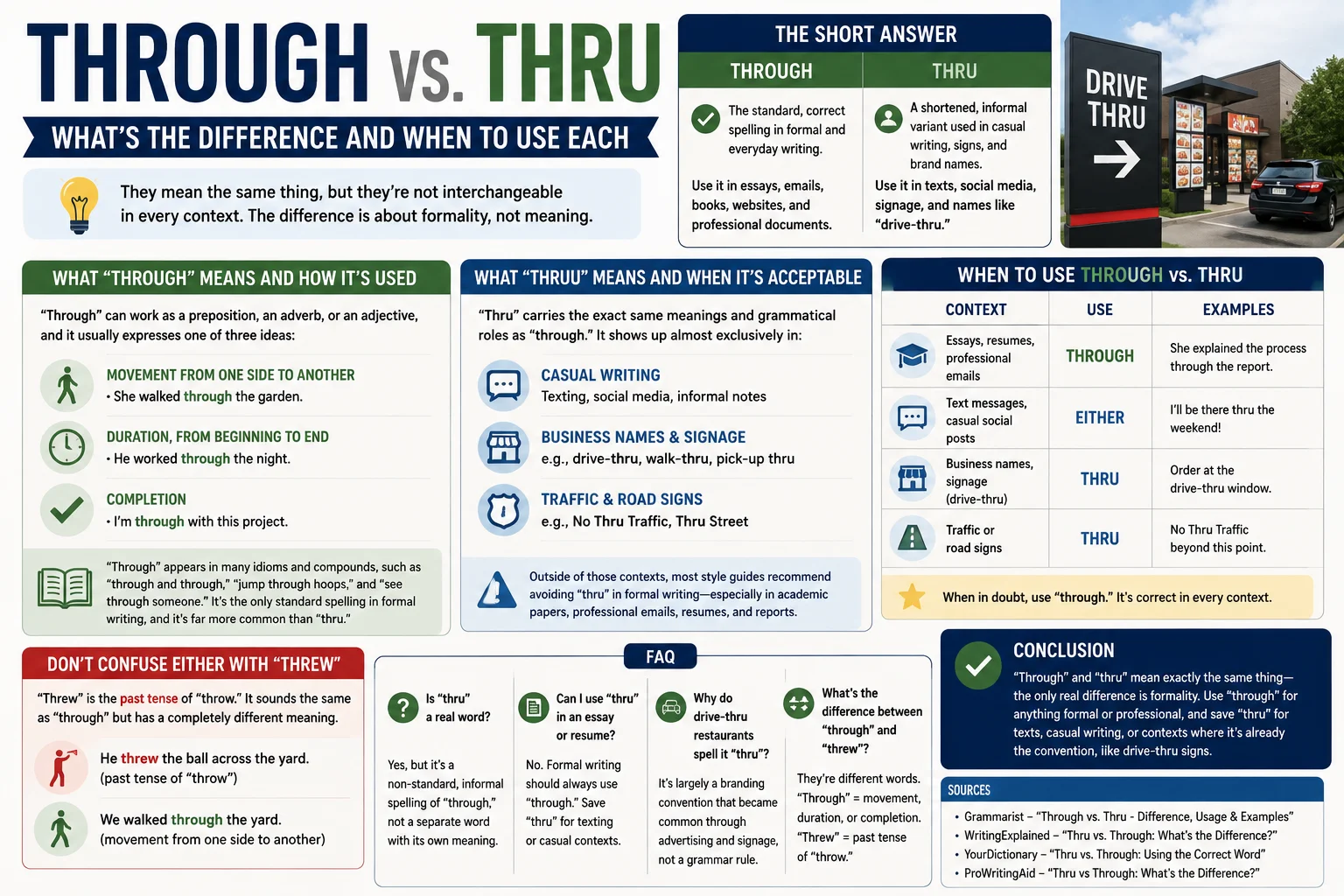
"Thru" isn't a different word from "through" it's an informal spelling of it. Both mean the same thing, but they're not interchangeable in every context. Here's how to know which one to use.
The Short Answer
“Through” is the standard, correct spelling in formal and everyday writing. “Thru” is a shortened, informal variant that shows up mainly in casual writing, texting, road signs, and business names like “drive-thru.” They share the same meaning and grammatical function; the difference is purely about formality, not definition.
What “Through” Means and How It’s Used
“Through” can work as a preposition, an adverb, or an adjective, and it generally expresses one of three ideas:
- Movement from one side to another: She walked through the garden.
- Duration, from beginning to end: He worked through the night.
- Completion: I’m through with this project.
It also appears in a long list of common idioms and compound expressions, such as “through and through,” “jump through hoops,” and “see through someone.” Style guides like Fowler’s and Garner’s list “through” as the preferred and only standard spelling for formal writing, and it’s overwhelmingly more common in published writing than “thru.”
What “Thru” Means and When It’s Acceptable
“Thru” carries the exact same meanings and grammatical roles as “through” it’s simply a phonetic, shortened spelling. It shows up almost exclusively in:
- Casual texting or social media posts
- Business signage, most famously “drive-thru”
- Traffic signs, such as “No Thru Traffic”
Outside of those informal or branded contexts, most style guides recommend avoiding “thru” entirely, especially in academic papers, professional emails, resumes, or any formal document.
When to Use Through vs. Thru
| Context | Use |
| Essays, resumes, professional emails | Through |
| Text messages, casual social posts | Either works, though “through” is never wrong |
| Business names, signage (drive-thru) | Thru (by convention) |
| Traffic or road signs | Thru is common, but not universal |
If you’re ever unsure which one fits, “through” is always the safe choice it’s correct in every context, while “thru” is only appropriate in a narrower set of informal or branded situations.
Don’t Confuse Either With “Threw”
A third word often gets mixed up in the same conversation: “threw,” the past tense of “throw.” It sounds identical to “through” but has a completely different meaning and spelling.
- He threw the ball across the yard. (past tense of “throw”)
- We walked through the yard. (movement from one side to another)
Since “threw,” “through,” and “thru” can all sound alike in casual speech, mixing them up in writing is a common and easily avoidable mistake.
FAQ
Is “thru” a real word?
Yes, but it’s a non-standard, informal spelling of “through,” not a separate word with its own meaning.
Can I use “thru” in an essay or resume?
No. Formal writing should always use “through.” Save “thru” for texting or casual contexts.
Why do drive-thru restaurants spell it “thru”?
It’s largely a branding convention that became common through advertising and signage, not a grammar rule.
What’s the difference between “through” and “threw”?
They’re different words entirely. “Through” describes movement, duration, or completion. “Threw” is the past tense of “throw.”
Conclusion
“Through” and “thru” mean exactly the same thing the only real difference is formality. Use “through” for anything formal or professional, and save “thru” for texts, casual writing, or contexts where it’s already the convention, like drive-thru signs.
Sources
- Grammarist “Through vs. Thru – Difference, Usage & Examples”
- WritingExplained “Thru vs. Through: What’s the Difference?”
- YourDictionary “Thru vs. Through: Using the Correct Word”
- ProWritingAid “Thru vs Through: What’s the Difference?”
